
Liquidated damage
Understand liquidated damages, calculation methods, enforceability considerations, delay damages, penalties, indemnities, and consequential loss.
General information for business contracts. Legal outcomes depend on the agreement, governing law, and circumstances; obtain jurisdiction-specific advice when needed.
On this page

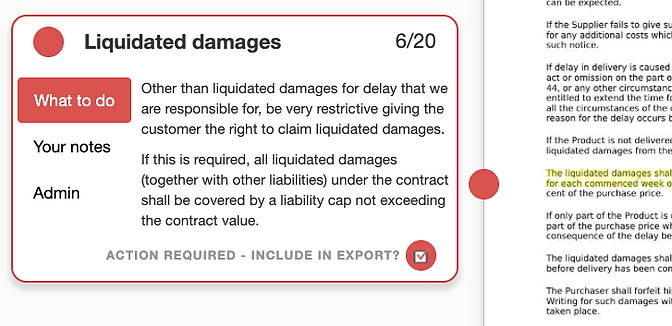
Example of feedback to a liquidated damage clause.
Key takeaways
- Tie liquidated damages to a clearly specified breach and a transparent calculation method.
- Check applicable penalty rules and whether the amount is proportionate to the protected interest.
- State whether liquidated damages are exclusive or cumulative with termination, indemnity, and other remedies.
What are liquidated damages?
Liquidated damages are an amount or calculation method agreed in advance for a specified breach, often delay or failure to meet a measurable commitment. They can provide predictability and reduce the need to quantify loss after the event. Enforceability depends on the clause and governing law, including any rule against penalties, so the trigger and amount should be commercially justified.
A liquidated damage provision will be enforced when…
This can differ according to the laws by which the contract is governed. However, a rule of thumb is the following.
Liquidated damage provisions will be enforceable when:
Damages are difficult to get a clear estimation of
A court will likely enforce a liquidated damages clause if the nature of the damages is difficult to estimate. Topics such as breach of a confidentiality agreement, trade secrets, intellectual property, all of these, and more could be topics that are unclear or difficult to get a clear number on when it comes to damages.
The amount in the liquidated damage clause is reasonable and not a penalty
A liquidated damages clause is more likely to be enforceable if the damages are proportionate to the breach that it is meant to compensate. In contrast, if the liquidated damage clause is more similar to a penalty or punishment, it is less likely to be enforced. This assessment may be made in the context of what was reasonable at the time of the creation and signing of the commercial agreement.
How are liquidated damages calculated?
Liquidated damages are calculated and utilized when it is difficult to set an amount on the damage caused. Generally, the nature of damages in which the liquidated damage clause deals is difficult to set an amount on, and therefore, a liquidated damage clause needs to be used. General practice states that each party to the contract should outline the amount a breach would cost them and negotiate where the fair amount lies between the parties. Depending on the type of contract (Service, NDA, etc.), this will determine the standards under which it may be viewed. The amounts that are drawn out should reflect a reasonable attempt to recoup losses and instead, not be a punitive fee. Make sure you find the liquidated damage to be reasonable when reviewing a contract.
Worked example: liquidated damages for delay
Assume a delivery contract worth €200,000 includes liquidated damages of €1,000 for each day of delay, capped at 10% of the contract value. A 25-day delay would produce €25,000 in calculated damages, but the contractual cap would limit the amount to €20,000.
Whether the clause is enforceable depends on the governing law and the circumstances. The amount should be connected to a reasonable estimate of loss and should not operate as a punishment.
When to use liquidated damages
Situations in which liquidated damages may be expected often appear in contracts such as the following cases.
IT Development contracts
Liquidated damages may be utilized in these contracts when completion of the commercial agreement is delayed due to the fault of a party’s breach. In this instance, the breaching party will be liable to pay the other party a specified sum over a period as outlined in the contract. The frequency of the payment may be each day, week, or month during which the delay continues on.
Construction contracts
Similar to IT development contracts, construction contracts will often use liquidated damages in the instances of delayed deadlines as stipulated within the contract between parties. Depending on the contract, the specified sum outlined by the liquidated damages clause will be liable to be paid each day, week, or month depending on what is stipulated within the contract.
Employment contracts
Liquidated damages may also be found in employment contracts even though in the past it has been stated that it was unusual to find such a clause within these contracts. Liquidated damages nowadays may come in the form of exposing trade secrets, industry practices, etc.
Non-Disclosure Agreements (NDAs)
Liquidated damages are commonplace within NDAs as before commercial agreements are entered into, there is often an exchange of information through negotiation of commercial matters. This discussion may include aspects that are difficult to set a price or value on such as the disclosure of intellectual property, trade secrets, or sensitive information. In these cases, liquidated damages are typically used in order to recoup damages of these more difficult types of breaches to establish and quantify.
Liquidated vs unliquidated damages
Liquidated damages are those payable for a breach of contract by one of the parties and are stipulated before the conclusion of the contract. In contrast, unliquidated damages are those arising from a party’s breach that has not been pre-estimated and, therefore, is granted on the basis of an assessment of the loss and the breach of the contract. These damages may be unforeseeable.
Similar to liquidated damages, for an unliquidated damages clause to be established, there must be a breach of contract. In most cases, for unliquidated damages, there must also be proof of damage or loss that is established to connect the right to receive compensation for the loss incurred.
The principles of unliquidated damages may attempt to balance factors such as:
That the parties should be returned to the position that they were in, before the breach;
That the damages awarded should not reflect a penalty;
A balance must be struck between compensating for the breach and turning it into a punitive act.
A clause for unliquidated damages may be a huge advantage as it can help a party recover certain losses that were unforeseeable or difficult to calculate. This can potentially be a disadvantage. However, because the parties to the contract may not want to expose themselves to unknown liability, this could be a difficult clause to negotiate. Possible disadvantages for the party enforcing an unliquidated damages clause are that they may have to prove that a loss occurred, that the loss was a result of the breach of the contract, and that it was not too remote.
Liquidated damages versus penalties
A penalty clause is a contractual clause that enforces one party to pay an agreed amount of money if there is a breach of contract that was stipulated in the agreement. The key distinction between a penalty clause and a liquidated damage clause is that the penalty clause is formulated to be a punishment for a breach of contract while the liquidated damage clause is intended to provide compensation.
For a clause to be classified as a penalty clause, the amount of money that is payable must be excessive and disproportionate to the actual loss incurred. This excessiveness in light of the breach will determine whether it is classified as a penalty clause.
Liquidated damages vs indemnity
Liquidated damages predetermine compensation for a specified breach. An indemnity is a contractual promise to compensate defined losses when its trigger occurs and is not limited to third-party claims unless the clause says so. Their proof requirements, caps, procedures, and interaction with other remedies depend on the drafting and governing law.
Liquidated damages vs consequential loss
Consequential-loss language identifies categories of recoverable loss that may be excluded or preserved after breach. Liquidated damages instead set an agreed amount or calculation for a specific breach. A liquidated-damages payment is not inherently consequential loss; the contract should state how it interacts with exclusions, caps, and other remedies.
Liquidated damages for delay
Commonplace in contracts such as construction or production-related contracts is that they include liquidated damages for delay clauses that are often used to protect against possible losses arising from a delay. This is often stipulated within the commercial agreement to protect parties but could also be useful for the breaching party to address and account for these costs ahead of time. In the process of reviewingand negotiating liquidated damages for delay, all parties should discuss a daily rate that the liquidated damages should cost and address how the daily rate was estimated. Without evidence of how the liquidated damage for the delay is calculated, the sum stipulated within the contract could be deemed as unenforceable. Early completion bonus clauses may also be written into the contract as a reward that incentivizes early deliveries and can make the liquidated damages clause more acceptable.
Disclaimer
Please note that this document is not legal advice. Legly, and its representatives, are not responsible for the content herein or the suitability for your company’s business. We recommend you use this in conjunction with legal advice and not as a substitute.
Review contracts with more confidence
Upload a contract and let Legly highlight risky wording, missing clauses, and points that deserve closer review. Try up to two documents every 90 days.
Review a contract free