
Practical guide
Contract Review: Process, Risks, and Best Practices
Contract review checks whether an agreement reflects the deal, makes obligations workable, and allocates risk intentionally.
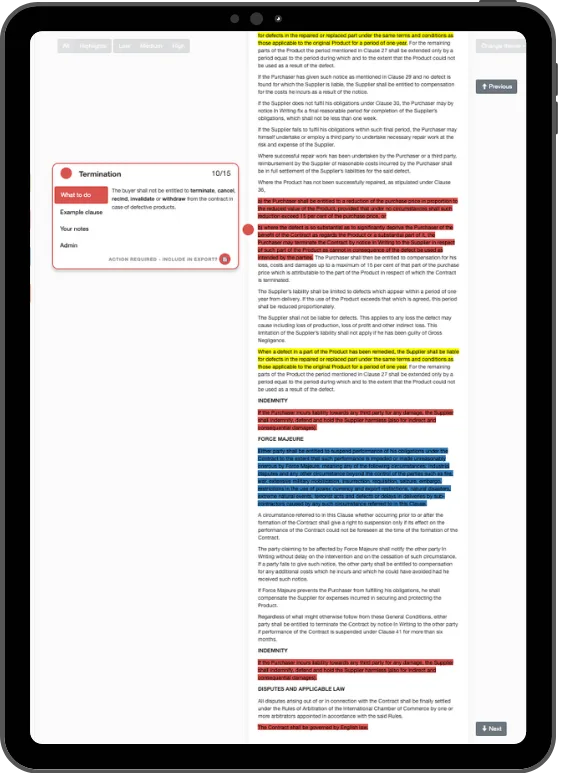
General information for business contracts. Legal outcomes depend on the agreement, governing law, and circumstances; obtain jurisdiction-specific advice when needed.
On this page
Key takeaways
- Review the business deal and the legal wording together.
- Prioritize material deviations instead of treating every clause equally.
- Read liability, indemnity, insurance, and remedies as one risk system.
- Use AI for triage and consistency, with human validation and escalation.
Contract Review Process (Step by Step)
In short: A reliable contract review connects the draft to the business objective, applies an agreed risk position, and records who accepts each material deviation.
Confirm context
Identify the agreement type, parties, commercial goal, governing law, deadlines, and who must approve deviations.
Read for structure
Map definitions, obligations, payment, delivery, term, termination, remedies, and documents incorporated by reference.
Test risk allocation
Review liability, indemnities, warranties, insurance, confidentiality, intellectual property, data protection, and dispute provisions together.
Record issues
Separate deal-breakers from negotiable points, explain the business impact, and propose clear replacement wording where appropriate.
Approve and document
Confirm stakeholders accept the final position, preserve the review trail, and ensure the signed version matches the approved draft.
Practical Contract Review Checklist
Use this baseline to check the commercial deal, scope and delivery, responsibilities and remedies, data and intellectual property, and governing law. Adapt it to the agreement type, value, jurisdiction, and your internal playbook.
Clause-by-Clause Contract Guides
In short: Review connected clauses together because changing one risk allocation can change the practical effect of another.
Checklist For Contract Review: Which commercial, operational, and legal points should be checked before signing?
Contract Review Software: How can software support a consistent, human-validated first review?
Delivery Terms: Who handles transport, cost, customs, insurance, and delivery risk?
Force Majeure: Which disruptive events qualify, what notice is required, and what relief follows?
Governing Law: Which law governs and where will disputes be decided?
Indemnity: Who bears specified third-party or other losses, and under what procedure?
Indirect Damage: Which loss categories are excluded, preserved, or defined?
Intellectual Property Rights: Who owns existing and newly created IP, and what is licensed?
Liability Cap: What is the maximum exposure and which claims sit outside the cap?
Liquidated Damage: Is compensation agreed for a specific breach, and how is it calculated?
Payment Terms: When is payment due and what happens if an invoice is disputed or late?
Sales And Purchase Agreements: How do scope, delivery, payment, remedies, and risk allocation work together?
Software Licensing Agreement: What use rights, restrictions, ownership, audit, and exit terms apply?
Manual vs AI-Assisted Contract Review
In short: AI can accelerate a first pass and improve consistency, while people remain responsible for context, negotiation, approval, and legal judgment.
Many teams can handle the first pass with a structured process, even without a legal background; qualified counsel should review material, unusual, or jurisdiction-specific risk.
| Criterion | Manual review | AI-assisted review |
|---|---|---|
| Speed | Reviewers locate and organize terms manually. | Software can extract and organize terms for validation. |
| Consistency | Consistency depends on reviewer time and experience. | A defined playbook can be applied repeatedly across drafts. |
| Context | People assess the deal, relationships, and practical constraints. | Output must be checked against context supplied by people. |
| Issue detection | People identify legal and commercial significance. | Software can flag clauses, missing terms, and deviations for attention. |
| Audit trail | Notes and approvals require disciplined documentation. | Structured workflows can make findings and decisions easier to trace. |
Cost and When to Involve Legal Counsel
In short: Review effort depends more on risk and complexity than document length. Escalate material, unusual, or jurisdiction-specific issues to qualified counsel.
What affects review effort?
Length alone is a poor measure. Agreement type, deal value, unfamiliar wording, governing law, data and security obligations, stakeholder count, and negotiation rounds usually matter more.
When should counsel review?
Seek qualified advice for material exposure, unusual indemnities or uncapped liability, regulated activity, cross-border issues, important intellectual property or data rights, disputes, or any point the team cannot confidently assess.
Frequently Asked Questions About Contract Review
What is contract review?
Contract review is a structured assessment of an agreement's commercial terms, obligations, risk allocation, remedies, and approval requirements before signing or amendment.
Who should review a business contract?
The right reviewers depend on the agreement. Commercial owners should confirm the deal, relevant specialists should assess the commitments they own, and qualified counsel should address material or jurisdiction-specific legal risk.
Can AI replace a lawyer for contract review?
No. AI can accelerate a first pass, organize clauses, and flag wording for attention, but people must validate the output against the source document, deal context, and approved positions.
How long does contract review take?
Contract review time depends on complexity, deal value, draft quality, stakeholders, and negotiation rounds. A repeatable checklist and AI-assisted first pass can reduce triage time without removing necessary approval or legal analysis.
What are common contract red flags?
Common red flags include unclear scope, uncapped liability, broad indemnities, weak termination rights, vague acceptance criteria, unexpected renewal, and obligations that the business cannot operationally meet.
When should a contract issue be escalated?
Escalate an issue when it exceeds an approved risk position, creates material or unusual exposure, involves regulated or cross-border activity, or cannot be confidently assessed by the responsible team.
Do I need a contract template or a contract review?
A template gives you a starting point when you are drafting an agreement yourself. A review tells you what an agreement already in front of you actually commits you to. If a counterparty has sent you a draft, a template will not answer the question you have — you need that specific wording checked.
Ready to Review Contracts Faster?
Standardize your first review and identify the clauses that deserve closer attention.
Disclaimer
This content is general information and is not legal advice.