
Intellectual property rights, IPR
Learn how contracts address ownership, licensing, confidentiality, and protection of intellectual property rights, with key review questions.
General information for business contracts. Legal outcomes depend on the agreement, governing law, and circumstances; obtain jurisdiction-specific advice when needed.
On this page

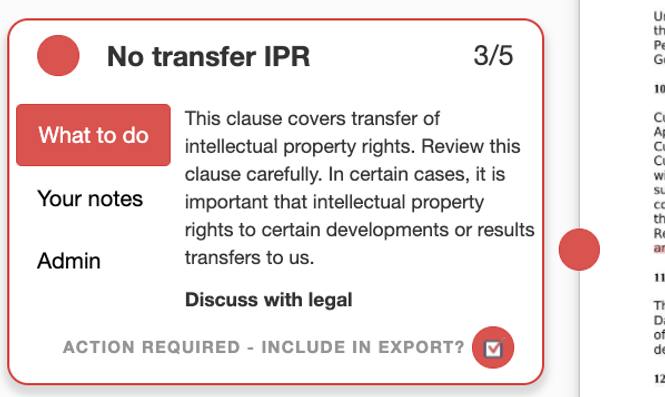
Example of feedback to a IPR clause from a buyers perspective.
Key takeaways
- Separate pre-existing IP from IP created while performing the agreement.
- Define ownership and every licence by scope, territory, duration, users, transferability, and permitted purpose.
- Check contractor/employee assignments, open-source obligations, confidentiality, and infringement remedies.
What are Intellectual Property Rights?
Intellectual property rights protect different kinds of creations and commercial identifiers. Patents, registered trade marks, and registered designs generally depend on registration, while copyright commonly arises automatically when qualifying work is created. Trade secrets depend on confidentiality and protective measures. Scope, duration, ownership, and enforcement vary by right and jurisdiction.
Why are IPRs important?
Intellectual property protection is extremely important to the protection of ideas, businesses, and creative work as these rights allow for innovation to occur. Without these rights, creators and inventors would not receive the full benefits of their work, which could potentially hurt the flow of innovation and creativity.
It is widely recognised that IPRs contribute to domestic and international economics as many different industries heavily rely on the protection and enforcement of patents, copyrights, and trademarks. For this reason, within contracts, intellectual property clauses will be found in most agreements but in different variations. When reviewing a contract these clauses will typically outline that each party retains ownership over their intellectual property unless stated otherwise.
The intellectual property clause is particularly relevant in licensing agreements as it will typically need to explicitly state that the only rights that are transferred are those that are expressly mentioned in the agreement. This means that a license is not a transfer or sale, and it does not affect the ownership of the asset. As a result, the licensee does not own the intellectual property that has been licensed. In the event of any modifications to the licensed intellectual property, the modifications or improvements made will all belong to the licensor in these instances, unless negotiated otherwise. These modifications will potentially be a contentious issue during negotiations as these points will typically vary from contract to contract.
Why should IPR be protected?
IPRs are crucial to keeping your competitors from using your ideas for their own profits without your consent. Thus, Intellectual property needs to be protected by the law to, first, prevent the theft of ideas and offerings. Inadequately protection provided for your intellectual property by, for example, not formulating your rights clearly enough, could lead to expensive and lengthy disputes that can be financially devastating for small business.
Intellectual Property Rights sample clause
Illustrative wording, not a template: Each party retains ownership of intellectual property it owned before the agreement. On payment, the supplier grants the customer a non-exclusive, worldwide licence to use the agreed deliverables for the customer's internal business purposes. Third-party materials remain subject to their applicable licence terms.
The parties should define ownership, licence scope, restrictions, feedback, open-source components, warranties, and what happens on termination.
Are IPR disputes arbitrable?
Since intellectual property rights may be governed in varying ways and depending on the law and jurisdiction, arbitration in the context of intellectual property disputes. IPRs will normally be granted by individual states and, therefore, disputes can quickly become an international matter. Depending on whether the intellectual property law is common law or civil law, it will influence which intellectual property rights can be arbitrated. In most jurisdictions, categories such as patents, copyright, trade secrets, trademarks, and domain names will be recognised universally. The Convention Establishing the World Intellectual Property Organisation highlights in article 2(viii) a general definition of intellectual property rights:
Scientific discoveries
Industrial designs
Trademarks, service marks and commercial titles
Protection against unfair conduct
Rights stemming from intellectual production from industrial, scientific, literary, or artistic works
Inventions
Infringements relating to these intellectual property rights can result in disputes and subsequent litigation and arbitration. However, the arbitration of the validity of intellectual property rights can either be not arbitrable or very limited. This is due to fact that the validity of intellectual property will often be processed by the relevant country’s intellectual property law procedures and will be subject to that jurisdiction.
In addition, disputes over intellectual property will be subject to what was negotiated within the commercial agreement, as a choice of law and jurisdiction should be outlined within the governing law clause.
Clear differences from civil law and common law are the following:
Civil law systems expressly recognise the full arbitrability of issues such as the common law exception of the validity of intellectual property rights.
Civil law systems will accept the inter partes awards or incidental decisions for issues of patent validity.
IPR and NDAs
The Non-Disclosure Agreement or ‘NDA’ is a legal agreement between parties that stipulates a promise not to disclose certain information discussed within the context of the agreement. They are typically used when two or more parties engage in a commercial agreement.
The purpose of a NDA is to protect business plans, confidential information, or trade secrets that were shared during negotiation between parties. In the context of intellectual property rights, NDAs are commonly used to prevent the infringement of valuable intellectual property rights and will allow for parties to share intellectual property while protecting themselves from possible breaches. Common practice for NDAs will typically stipulate that any breaches of confidential information or trade secrets may result in litigation and damages. So, review NDAs carefully.
Disclaimer
Please note that this document is not legal advice. Legly, and its representatives, are not responsible for the content herein or the suitability for your company’s business. We recommend you use this in conjunction with legal advice and not as a substitute.
Review contracts with more confidence
Upload a contract and let Legly highlight risky wording, missing clauses, and points that deserve closer review. Try up to two documents every 90 days.
Review a contract free