
Delivery terms and Incoterms
Understand delivery terms and all 11 Incoterms 2020 rules, including responsibilities, costs, insurance, and when risk transfers between parties.
General information for business contracts. Legal outcomes depend on the agreement, governing law, and circumstances; obtain jurisdiction-specific advice when needed.
On this page

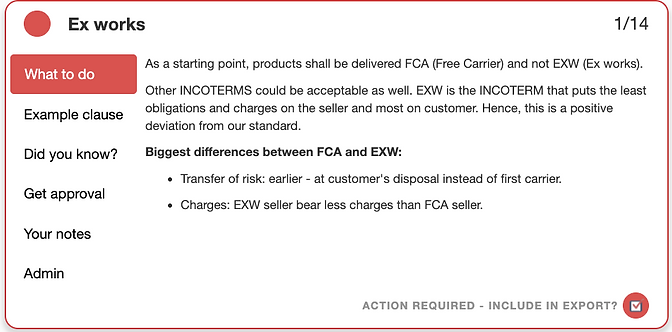
Example of feedback to a delivery term in a business contract.
Key takeaways
- Use the current ICC Incoterms 2020 rule and name the exact place or port.
- Incoterms allocate delivery tasks, costs, and risk; they do not replace the rest of the sales contract.
- The point where risk transfers may differ from the point to which the seller pays transport costs.
- DDU is not an Incoterms 2020 rule; current contracts normally use DAP, DPU, or DDP as appropriate.
What are delivery terms?
Delivery terms allocate the parties' obligations for making goods available, transport, documents, costs, customs, insurance, and the point where delivery risk transfers. Ownership or title is a separate issue and should be addressed expressly in the sales contract; Incoterms do not determine when ownership passes or replace payment, warranty, or remedies clauses.
For a complete contract review workflow, see our guide to contract review.
What are Incoterms?
Incoterms stands for International Commercial terms and were created for the purpose of assisting international companies from different countries to interpret and apply uniform transport agreements. These terms were issued by the International Chamber of Commerce (ICC). This is done through a standardized set of international delivery terms that can be applied as a legal agreement between buyers and sellers. In general, incoterms will outline responsibilities, allocate risk between parties, and detail the costs associated with the transportation of the goods. Incoterms will be largely used in the context of export, import, and the transit of goods, but incoterms will also impact factors such as transport insurance, the location of the delivery, transfer of risk, and many more.
Why are incoterms important?
Incoterms are crucial to the international shipment of goods as these standardized terms function to clearly allocate risk, divide obligations and share the costs associated with transporting goods. Incoterms will also clarify a lot of specifics relating to documents of the goods sold, customs fees, shipping insurance, packaging, and many more. The current Incoterms have 11 different terms, which provide for different allocations of costs, risks, insurance, and many more details. Incoterms, however, do not cover all the conditions of a sale, nor do they:
stipulate the price of the goods,
specify when the ownership passes from seller to buyer,
specify which documents are needed to facilitate or
addresses the liability for late delivery.
How do incoterms work?
Out of the 11 incoterms available, the seller will first determine which incoterms will be used that make the most sense. The chosen incoterm will then be written into purchasing or shipping contracts, determining factors such as if carrier companies will be involved and how the goods will be transported. The seller might be given a bill of lading if a carrier company was employed to transport the goods, as this bill will prove that the goods have been taken on the carrier.
Incoterms 2020 at a glance
A compact comparison of the delivery point and seller-paid carriage. Always pair the rule with a precise named place or port.
| Rule | Transport | Delivery / risk transfer | Seller-paid carriage |
|---|---|---|---|
| EXW | Any mode | Goods placed at buyer's disposal at the named place, not loaded | No |
| FCA | Any mode | Goods delivered to the carrier or person nominated by buyer at the named place | No |
| CPT | Any mode | When goods are handed to the carrier | Yes, to named destination |
| CIP | Any mode | When goods are handed to the carrier | Yes, plus required insurance |
| DAP | Any mode | Goods ready for unloading at the named destination | Yes, to named destination |
| DPU | Any mode | Goods unloaded at the named destination | Yes, including unloading |
| DDP | Any mode | Goods import-cleared and ready for unloading at named destination | Yes, including import formalities |
| FAS | Sea / inland waterway | Goods placed alongside the vessel at port of shipment | No |
| FOB | Sea / inland waterway | Goods placed on board at port of shipment | No |
| CFR | Sea / inland waterway | Goods placed on board at port of shipment | Yes, to destination port |
| CIF | Sea / inland waterway | Goods placed on board at port of shipment | Yes, plus required insurance |
What does delivery term Ex works mean?
Ex works is an incoterm that refers to an international trade term that outlines how the buyer must cover the transport costs when the seller makes the product available at the designated location. Once buyers have received the goods, the responsibility shifts to the buyer for such risks as loading the goods, transferring them on ships or planes, and meeting certain customs regulations. Ex works within the context of a contract will typically favor the seller and be more of a liability for the buyer, as the seller will only be responsible for safely packaging the goods, labeling them, and delivering these goods to the agreed-upon location. It may also be stipulated in an Ex works clause that the seller must help the buyer obtain export licenses or other required paperwork.
On the other hand, the buyer may be exposed to a wider range of risks as once the buyer receives the goods, the buyer must:
Cover onward expenses relating to the goods
Be liable for risks relating to the loading of products, transfer, dealing with customs, unloading the products, storing, and selling of the product
What does delivery term CIF mean?
Cost Insurance and Freight (CIF) is an Incoterms 2020 rule for sea and inland-waterway transport. The seller places the goods on board, contracts and pays for carriage to the named destination port, and obtains the required minimum insurance cover. Risk transfers when the goods are on board at the port of shipment, not when they reach the destination port.
Use the contract review guide to assess the delivery, risk, and payment obligations together.
What does delivery term CFR mean?
Cost and Freight (CFR) is an Incoterms 2020 rule for sea and inland-waterway transport. The seller places the goods on board and pays carriage to the named destination port, but risk transfers to the buyer when the goods are on board at the port of shipment. Unlike CIF, CFR does not require the seller to arrange cargo insurance.
What does delivery term FAS mean?
Free Alongside Ship or FAS is an international trade term that outlines the seller must arrange for goods to be delivered and transferred to a designated port. The designated port can be a loading dock or barge but not a container terminal. This term is relevant to goods transported via ocean, sea, or waterway. The buyer is responsible for loading the freight onto the shipping vessel, handling local carriage, importation procedures and duties, and the carriage to the final location.
What does delivery term CIP mean?
Carriage and Insurance Paid To (CIP) is an Incoterms 2020 rule for any mode of transport. The seller contracts and pays for carriage to the named destination and obtains the required insurance cover. Risk nevertheless transfers to the buyer when the goods are handed to the first carrier, so the named destination and the risk-transfer point should not be confused.
What does the delivery term DDP mean?
Delivered Duty Paid or DDP is an international trade term that outlines the seller is responsible for all the risks and costs associated with transporting goods until the goods reach either the agreed destination or the possession of the buyer. Such costs can include paying for shipping, insurance, import and export duties, and other associated costs that may occur during shipping. The seller, in this instance, has extensive responsibilities ranging from obtaining the appropriate approvals to organizing export and import requirements, which may deter some sellers from accepting these incoterms. DDP terms are usually used when the supply cost is predictable and stable.
What does delivery term DAP mean?
Delivered-at-place or DAP is an incoterm that outlines how the seller will take all the responsibility and the costs relating to moving goods sold to a specific location. In return, the buyer will be responsible for paying applicable local and clearance taxes and for import duties when the shipment arrives at the agreed-upon location. Similar to ex-works, DAP means that the seller will take on the costs and risks associated with delivering the goods to the agreed-upon location, where the buyer will take over the risk thereon in.
Ensure you understand the terms regarding DAP when reviewing a contract.
What does delivery term DPU mean?
DPU means Delivered at Place Unloaded. The seller is responsible for transport, risk, and unloading until the goods are unloaded at the named place. The buyer is normally responsible for import clearance, duties, and taxes.
DPU is the only Incoterms 2020 rule that requires the seller to unload the goods at destination. It replaced DAT in Incoterms 2020, so the named place must be suitable for safe unloading and the parties should define who provides the equipment and access needed.
The allocation of costs, risk, insurance, customs obligations, and the named place should be checked against the contract and the governing law.
Is DDU still used?
Delivered Duty Unpaid (DDU) is an older term and is not part of Incoterms 2020. Current contracts normally use DAP, DPU, or DDP depending on responsibility for unloading and import formalities. If a legacy agreement says DDU, define the intended obligations expressly rather than assuming the old label answers every delivery question.
What does delivery term CPT mean?
Carriage Paid To (CPT) is an Incoterms 2020 rule for any mode of transport. The seller delivers the goods to the carrier and pays carriage to the named destination. Risk transfers when the goods are handed to the carrier, which may occur well before they reach the destination for which the seller paid. CPT does not require the seller to obtain cargo insurance.
What does delivery term FOB mean?
Free on Board (FOB) under Incoterms 2020 applies to sea and inland-waterway transport. The seller delivers when the goods are placed on board the vessel nominated by the buyer at the named port of shipment; risk then transfers to the buyer. Expressions such as 'FOB destination' used in some domestic legal systems are different from the ICC Incoterms rule and should not be mixed with it.
What does delivery term FCA mean?
Free Carrier or FCA is an international trade term that outlines how the seller of goods is responsible for delivering goods to the agreed-upon location where they will be transferred to a carrier. This destination outlined in an FCA will be either a shipping terminal, warehouse, airport, or any other location where the agreed-upon carrier operates.
In an FCA delivery term, the seller will include transportation costs in the price of the goods and, in turn, will assume the risks associated with shipping the goods to the agreed-upon location. Once the carrier receives the goods, the buyer must then assume the risks relating to shipping the goods.
The carrier in these arrangements will be any company that specializes in transporting goods as a service.
How should buyers and sellers choose an Incoterms rule?
No Incoterms rule is automatically best for every buyer or seller. Choose based on transport mode, control of carriers, customs capability, insurance, bargaining position, and the locations where delivery and risk should transfer. State the rule, edition, and exact named place or port, for example 'FCA [named place], Incoterms 2020'.
Before choosing a rule, review the contract terms that allocate delivery, risk, and responsibility.
Disclaimer
Please note that this document is not legal advice. Legly, and its representatives, are not responsible for the content herein or the suitability for your company’s business. We recommend you use this in conjunction with legal advice and not as a substitute.
Review contracts with more confidence
Upload a contract and let Legly highlight risky wording, missing clauses, and points that deserve closer review. Try up to two documents every 90 days.
Review a contract free